🤖 Model 🖼️ → 🖼️
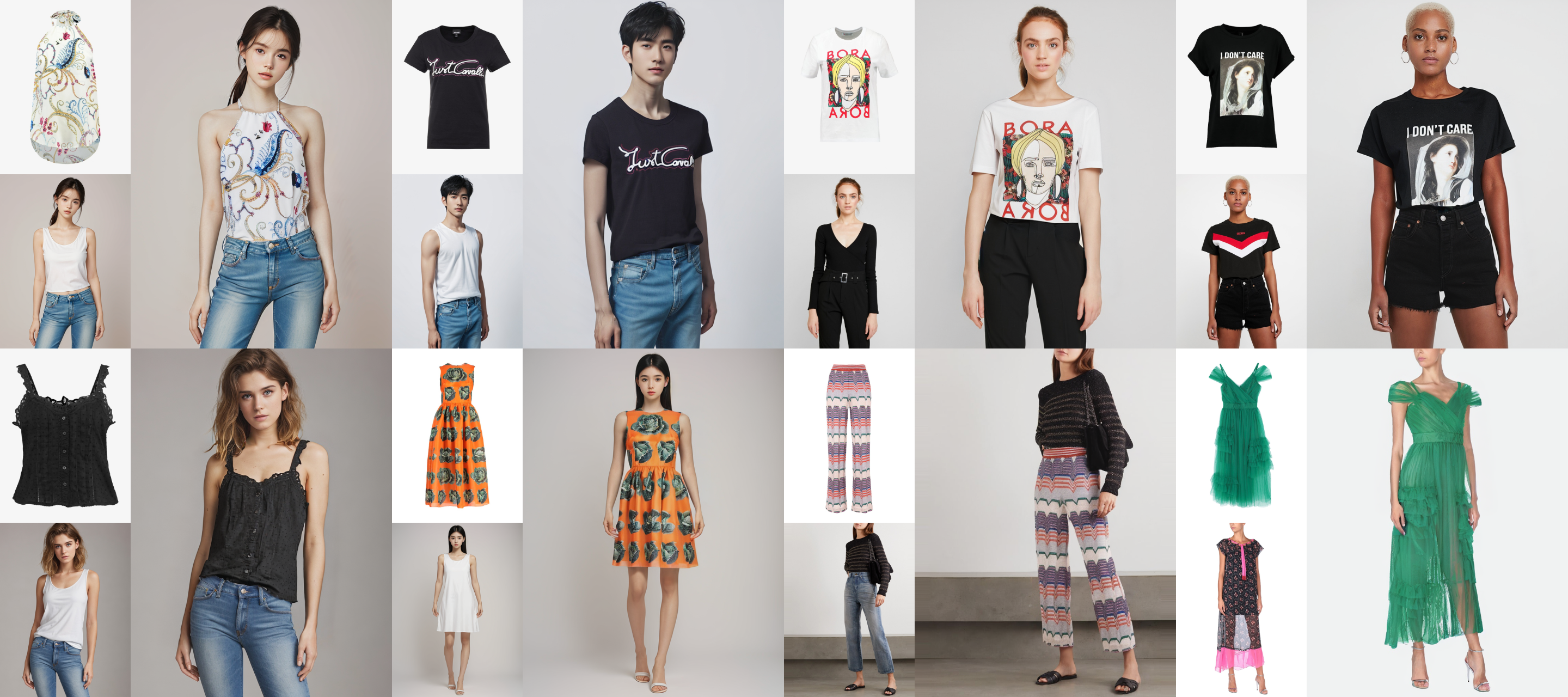
cuuupid/idm-vton
Virtually tries on clothing items by taking an image of a person and an image of a garment, returning a realistic image...
A virtual try-on API takes two images — a person and a garment — and returns the person wearing that garment. E-commerce teams use it for product pages, fashion apps use it for personalization, and marketplaces use it to generate on-model photos without a photoshoot.
On Replicate the clear leader is IDM-VTON (1.5M+ runs), with OOTDiffusion as the main alternative and a handful of niche e-commerce pipelines around them.
Start with cuuupid/idm-vton. It is the most-used try-on model on Replicate by a wide margin, takes a garment image plus a person image, supports a category input (upper body, lower body, dresses), and returns results in the tens-of-seconds range.
Use viktorfa/oot_diffusion as the comparison candidate — same person + garment workflow, different underlying architecture, useful as an A/B alternative when IDM-VTON struggles with a garment type.
Look at wolverinn/ecommerce-virtual-try-on when you want a prompt-driven pipeline (it exposes Stable Diffusion-style controls like prompt, cfg_scale, and scheduler) rather than a fixed two-image workflow.
| Use case | What matters | Start with |
|---|---|---|
| Virtual try-on API | Person photo + garment photo in, dressed person out | IDM-VTON |
| Clothing try-on AI | Try shirts, pants, dresses on model photos | IDM-VTON with the right category |
| E-commerce product photos on models | Batch on-model imagery without photoshoots | IDM-VTON, OOTDiffusion as fallback |
| Outfit visualization app | Interactive try-on in a consumer app | IDM-VTON (watch latency), queue results |
| AI fashion model generator | Generate the model too, not just the garment swap | Prompt-driven pipelines, then try-on |
| Model | Runs on Replicate | Example speed | Inputs | Best for |
|---|---|---|---|---|
| cuuupid/idm-vton | 1.5M+ | ~17s | garment + person image, category, steps, seed | Default choice, best garment fidelity |
| viktorfa/oot_diffusion | 26K+ | ~46s | model_image, garment_image, steps, guidance_scale | A/B alternative architecture |
| wolverinn/ecommerce-virtual-try-on | 3K+ | ~42s | prompt, cfg_scale, scheduler, max_width | Prompt-controlled e-commerce pipelines |
Latency is tens of seconds, not real-time. All current try-on models are diffusion-based; example runs range from ~17s (IDM-VTON) to ~45s. For interactive apps, run predictions async and notify the user, or pre-generate for known garment/model pairs.
Garment category matters. IDM-VTON's category input (upper body / lower body / dresses) meaningfully changes results — misclassifying a dress as an upper-body garment produces artifacts.
Input photo quality dominates output quality. Frontal person photos with clear garment visibility work best. Occluded poses, side angles, and layered clothing are where all current models degrade.
For the surrounding model landscape, browse the virtual try-on tag and the fashion tag.
Virtually tries on clothing items by taking an image of a person and an image of a garment, returning a realistic image...
Virtual try-on model that takes an image of a person and an image of an upper body garment, then generates images showin...
Generate virtual try-on images using Stable Diffusion and IP-Adapter from a face image and a commerce image containing c...
Use IDM-VTON as the production default — it has the usage, the garment-category control, and the best general fidelity. Keep OOTDiffusion wired up as a fallback for garments where IDM-VTON underperforms. Consider prompt-driven pipelines only when you need to control the scene, not just swap the garment.
All are pay-per-run on Replicate, so experimentation costs cents.
IDM-VTON is the most-used try-on model on Replicate (1.5M+ runs) and the best starting point for e-commerce and fashion apps. OOTDiffusion is the main alternative.
Not today. Diffusion-based try-on takes roughly 15–45 seconds per image on Replicate. Production apps run it asynchronously or pre-generate results.
Two inputs: a person photo (frontal, garment area visible) and a flat or on-model garment photo. IDM-VTON also wants the garment category — upper body, lower body, or dresses.
On Replicate you pay per run with no idle cost. At tens of seconds of GPU time per image, batch generation of a catalog is typically far cheaper than a photoshoot.